


Everyone knows the Steve Jobs story. Black turtleneck. Every day. Same one, or rather, one hundred of the same one, because when you are worth several billion dollars you can afford to have an existential crisis about your wardrobe and then solve it wholesale. The world called it genius. The world called it discipline. Think pieces were written. TED talks were given. A biopic was made. Nobody asked what his jewelry said about him. Because he was not wearing any.
Now. Let us talk about the women who have been doing this since before Steve Jobs was born and have received approximately zero TED talks for it.
A Brief and Overdue Definition
A uniform is not wearing the same thing every day. That is either a prison sentence or a very committed bit. A uniform is having decided something about yourself so thoroughly that your wardrobe simply reflects the verdict. It is dressing in permanent agreement with who you already are. Men do this and we call it vision. Women do this and we call it a phase, or a personality, or that thing she does. Same behavior, wildly different reception. Fashion, like most industries, has always had a complicated relationship with fairness.
The Founding Mothers of Not Changing
Coco Chanel built the most influential fashion house in history while essentially wearing a variation of the same outfit every day. Tailored jacket. Pearls. Two-tone shoes. Not because Mademoiselle lacked imagination, the woman invented modern femininity, but because she had so much imagination she refused to spend any of it on getting dressed. The uniform was the argument. Every morning she woke up and dressed and said, without opening her mouth: I have already decided who I am. Your move.
Georgia O'Keeffe moved to the New Mexico desert and wore black. Always black. Clean, severe, architectural black. In a landscape so colorful it practically argues with you, she chose to be the contrast. That is not minimalism. That is a specific variety of aesthetic arrogance that only the truly confident can pull off, and O'Keeffe pulled it off for roughly five decades without breaking a sweat.
Katharine Hepburn wore trousers when women wearing trousers was considered a form of low-grade social rebellion. She wore them anyway. Every day. With the energy of someone who had heard your opinion and found it genuinely interesting and also completely irrelevant. Eventually the trousers stopped being a statement and became simply who she was. Which, one suspects, was the point from the very beginning.
Reel Talk: What Fiction Got Absolutely Right
Fiction, to its credit, understood the feminine uniform long before the think pieces caught up. Miranda Priestly in The Devil Wears Prada never repeats an outfit, but she always repeats an energy. White hair, architectural silhouettes, the posture of a woman who has not needed external validation since the early 1980s and is not about to start now. That is her uniform. It is not clothing. It is a frequency. And everyone in her orbit dresses accordingly, which is the real power move: when your uniform becomes the dress code.
Olivia Pope wore white. Season after season of Scandal, crisis after crisis, assassination after cover-up after mild act of treason, the white coat remained. White as armor. White as the story she kept telling herself about who she was. The uniform was doing the narrative heavy lifting that the plot occasionally forgot to do. Shonda Rhimes understood that a woman's clothes are never just clothes. They are her ongoing argument with the world about herself.
And then there is Carrie Bradshaw, who technically had no uniform and therefore had the most disciplined uniform of all: the absolute, unwavering refusal of one. Every outfit maximalist, every look a production, every Tuesday an occasion. The consistency was chaotic. She dressed like a woman who had decided that the only rule was that there were no rules, and she applied that rule with the devotion of a religious text for six seasons and two films and a reboot that we are all pretending to have opinions about.
The Jewelry Chapter
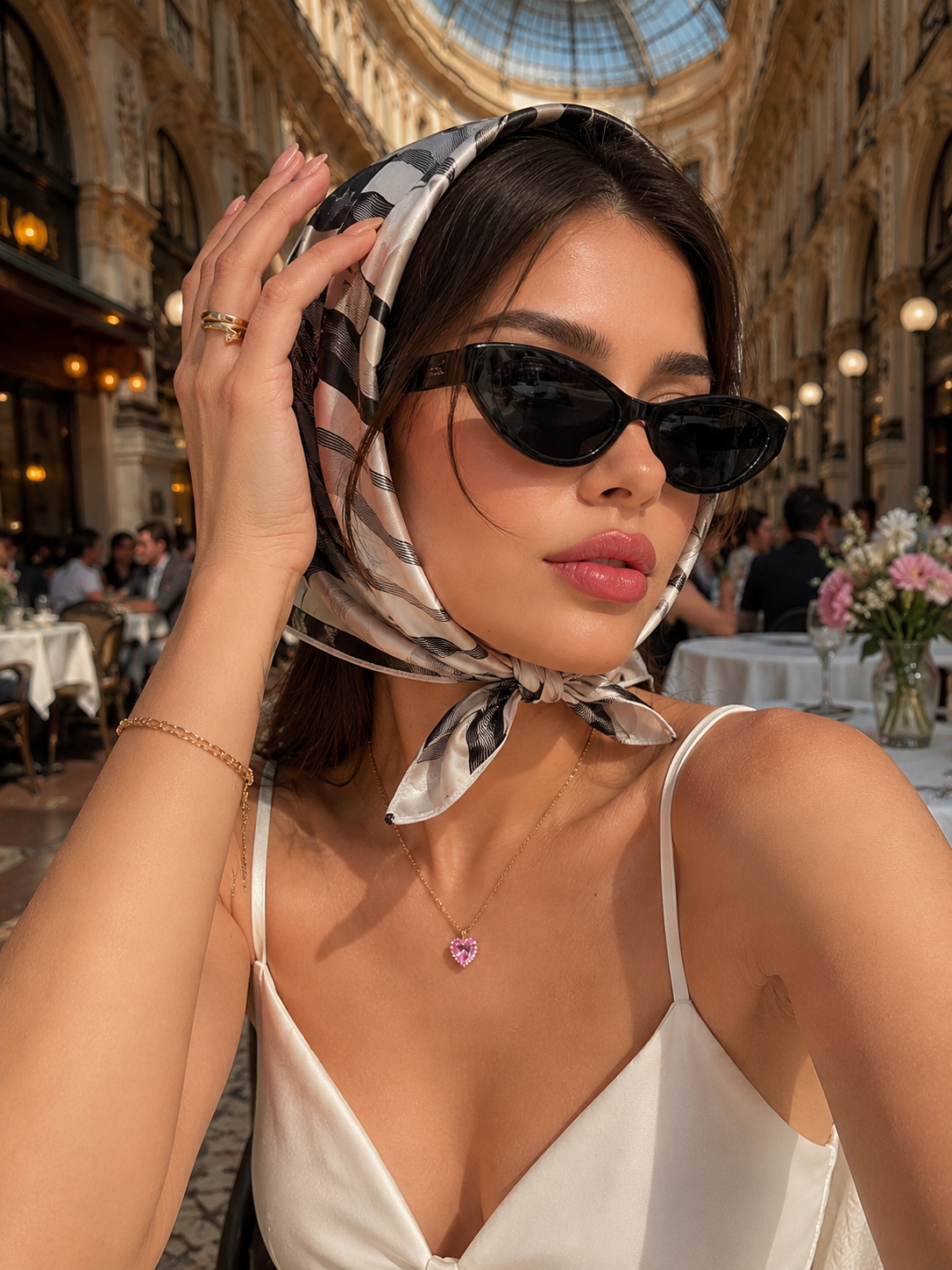
Here is the thing about the feminine uniform that nobody talks about, possibly because it requires paying actual attention. For most women, the uniform is not the clothing. Clothing is seasonal, situational, occasionally dependent on whether the laundry has been done. The clothing moves. The jewelry does not.
The clothes are the conversation. The jewelry is the signature at the bottom of the page.
Think of the women in your life with real presence. The ones who walk into a room and the room rearranges itself slightly. Now think about their jewelry. You can picture it exactly, can you not? Because it has not changed. There is the one who has worn the same gold hoops since university. The one whose delicate chain has not left her neck in four years. The one with the signet ring that has become so fully part of her hand that her fingers would look grammatically incorrect without it. That is the uniform. The jewelry is the constant. Everything else is just context.
A Field Guide
The woman who always wears a blazer, even casually, even to brunch: She does not fully trust any situation she cannot be slightly overdressed for. This is not insecurity. This is advanced preparation. She has been right about this more times than you know.
The woman who wears all black, always: She is not boring. She is ruthlessly efficient with her authority. Color is a negotiation. She has decided she is not negotiating.
The woman who has not changed her jewelry in three years: She has done something most people spend their entire lives circling. She has found her answer. She wears it every day. She does not explain it.
The Part Where We Make It Personal
Steve Jobs gets a Wikipedia section about his turtleneck. Karl Lagerfeld gets a documentary about his gloves. Obama gets a New York Times piece about his decision to wear only navy or grey suits. The men who wear uniforms are eulogized as evidence of extraordinary minds too occupied with greatness to bother with the mundane.
The woman who has worn the same pearl earrings to every boardroom, every dinner, every unremarkable Wednesday morning for the last decade just gets dressed. But she is doing the exact same thing. She has located herself. She has stopped the daily negotiation with the mirror about who she is today.
The women who have figured it out stop answering with words. They reach for the same earrings. And then they walk out the door.
The room takes note. It always does.